
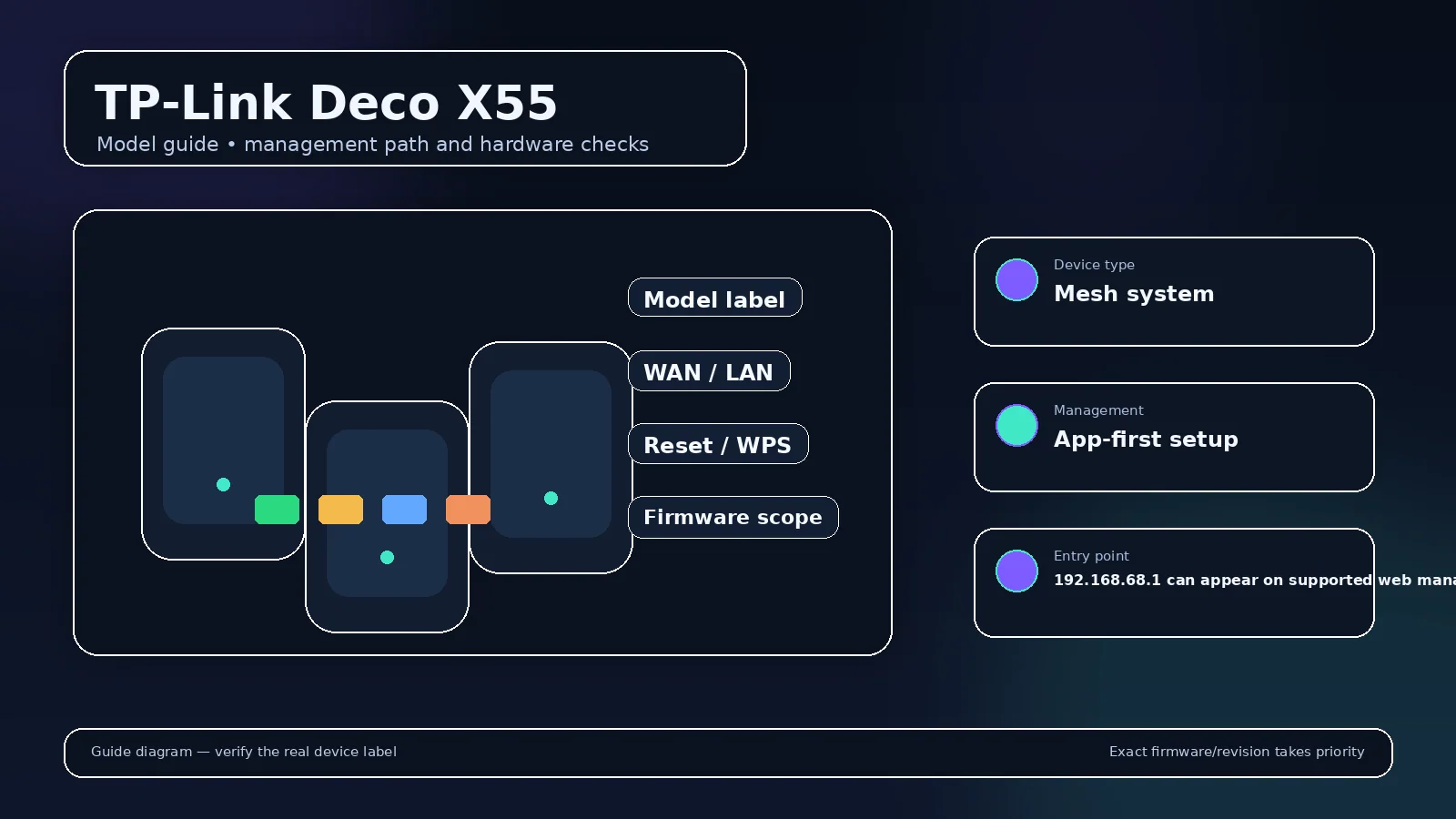
TP-Link Deco X55 login and setup information is scoped to this exact model. Treat Deco as a mesh system, not as a conventional single-router login page. The Deco app remains the primary management method, and TP-Link notes that web-management availability is model/firmware dependent.
TP-Link Deco X55 management details
| Management address | Deco app is primary; supported Deco firmware can also expose tplinkdeco.net / 192.168.68.1 web management |
|---|---|
| Administrator identity | TP-Link account/owner authentication rather than a legacy universal admin username |
| Administrator password | Account/owner credentials; web support and fields depend on firmware |
| Supported app/workflow | TP-Link Deco app |
| Documentation scope | Deco X55 hardware/firmware; web-management capability can vary by version |
Use this TP-Link Deco X55 page as a model-specific reference. It deliberately separates the local administrator credential from the Wi-Fi key and from any cloud/provider account, because those are different authentication paths even when a setup wizard lets an owner choose similar values.
Primary model documentation: official TP-Link Deco X55 source. Use the revision/region noted above when firmware or reset behavior is involved.
How to sign in to TP-Link Deco X55?
- Connect a trusted client to the TP-Link Deco X55 LAN by Wi-Fi or Ethernet.
- For TP-Link Deco X55, open the documented local hostname/address. If it fails, read that client device’s current Default Gateway instead of guessing another private IP.
- Authenticate with the administrator credential documented for this TP-Link Deco X55 setup state; do not substitute its wireless passphrase unless the exact interface explicitly asks for it.
- Use TP-Link Deco app only for the TP-Link Deco X55 controls and recovery functions that the cited documentation assigns to that workflow.
Troubleshooting local access to TP-Link Deco X55
If the browser cannot reach the TP-Link Deco X55, distinguish address discovery from authentication. A timeout points toward the wrong route, isolation, or an unavailable management service; a visible login form with a rejected password proves that local reachability is already working.
If the TP-Link Deco X55 administrator password is rejected
Check the label, setup record, password manager, and the official recovery method for TP-Link Deco X55. A normal reboot preserves the configured password. A factory reset is different: it can erase Wi-Fi, LAN, VPN, forwarding, parental-control, mesh, and WAN settings, so use it only when the documented TP-Link Deco X55 recovery path requires it.
Firmware and hardware scope for TP-Link Deco X55
Deco X55 hardware/firmware; web-management capability can vary by version. Before an upgrade, confirm the exact model/revision and regional support page, keep power stable, and avoid firmware intended for a similar-looking device. If this unit is carrier- or ISP-customized, provider firmware can change both the menu and the safe update path.
Configuration checks that matter on TP-Link Deco X55
- Confirm the administrator password is unique and stored separately from the Wi-Fi passphrase.
- Review wireless security and client compatibility before forcing a newer mode across every band.
- Check firmware only against the exact Deco X55 hardware/firmware; web-management capability can vary by version support scope.
- Review remote management, WPS, UPnP and port-forward rules instead of assuming the factory state is still appropriate.
- Keep a record of LAN subnet, DHCP reservations, DNS choices and any VPN or mesh role before a reset or major upgrade.
Why can Wi-Fi work while the TP-Link Deco X55 admin password fails?
Wireless association and administrator authentication are separate on the TP-Link Deco X55. The current administrator value follows this model’s setup/recovery rules; a working Wi-Fi key does not prove it should unlock the settings page.
Why can the usual TP-Link Deco X55 address open another device?
In a multi-router network, the client may be routed by an ISP gateway or another router while the TP-Link Deco X55 sits downstream or operates as an access point. Compare the client gateway and upstream device list before resetting either unit.
Confirm that the instructions match your exact unit
Deco X55 hardware/firmware; web-management capability can vary by version Check the printed model and, where shown, hardware revision before using a firmware file or reset sequence. If the router was supplied by an ISP or mobile carrier, provider firmware can change the sign-in path, hide radio/WAN settings, or replace the retail app workflow. The current default gateway on a connected client is the best clue when the remembered factory address no longer responds.
What to test after any configuration change?
- Local admin access still works from the main LAN.
- DHCP gives clients the intended address, gateway and DNS.
- Internet access works on both wired and wireless clients where applicable.
- Guest/IoT isolation still matches your security plan.
- Port forwards, VPNs or parental-control rules still target the intended devices.
Video walkthrough for TP-Link Deco X55
Explains mesh nodes, coverage, and practical deployment tradeoffs, useful when comparing mesh with wired access points or extenders.
Mesh WiFi Explained — What It Is and How It Works — Simple Networks. Watch on YouTube
Useful next steps
Deco X55 owner access
TP-Link Deco X55: deco X55 hardware/firmware; web-management capability can vary by version. The reference below is the support starting point; this is not a claim of physical testing on every revision.
- TP-Link Deco X55 check: treat Deco as a mesh system, not as a conventional single-router login page. The Deco app remains the primary management method, and TP-Link notes that web-management availability is model/firmware dependent. Official source 1
Illustrative case: An invited manager can manage some app functions but cannot use the browser panel. Check ownership and web-management support before resetting the whole mesh.
Does a Deco manager account have the same web access as its owner?
TP-Link’s Deco web guide distinguishes owner access from delegated managers. Use the owner workflow for the supported interface.
Documentation and scope