
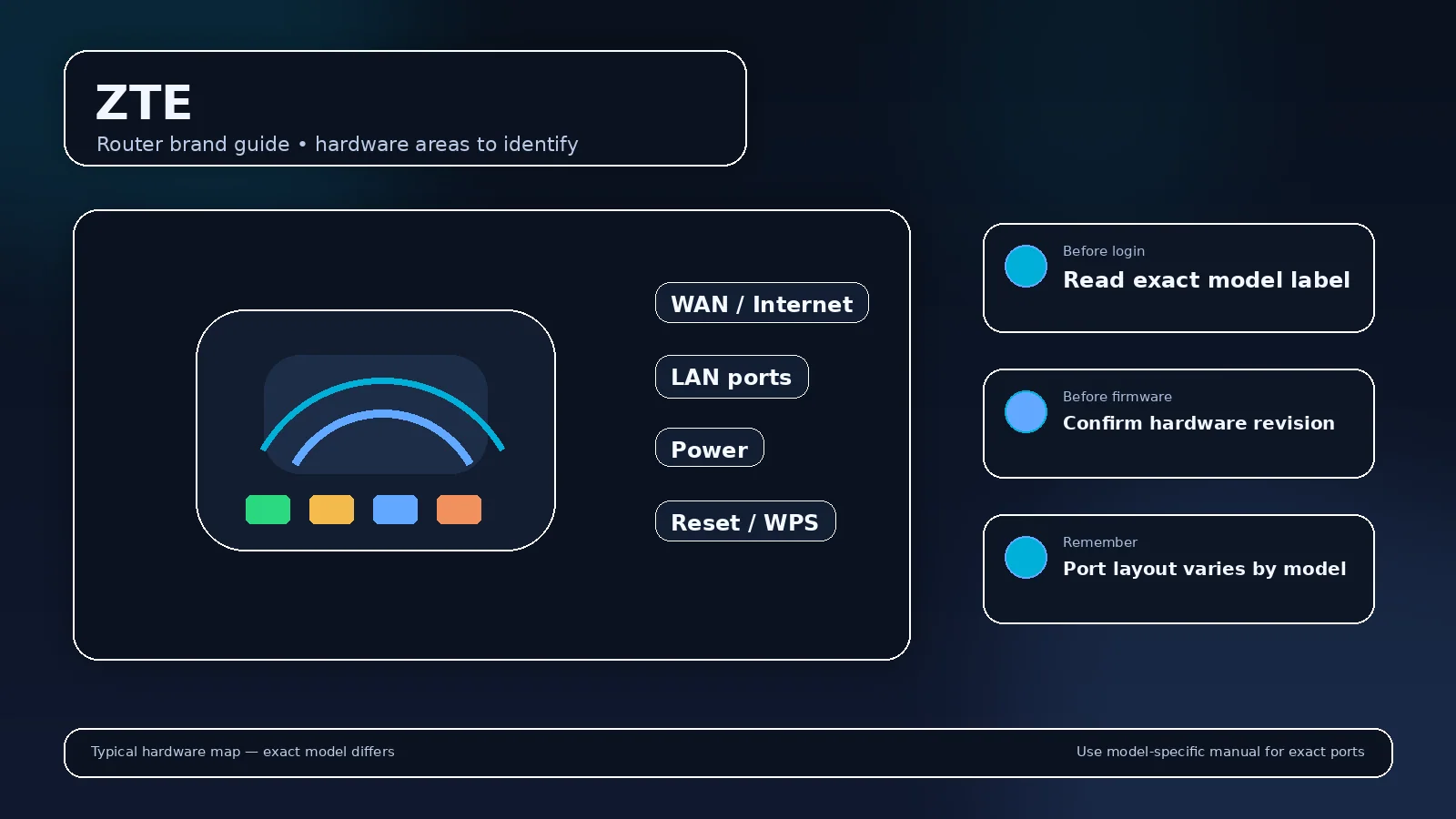
ZTE produces home routers, fiber gateways, mobile broadband routers, and 4G/5G CPE products. Much of this hardware reaches users through an ISP or mobile carrier, so provider-specific firmware is common.
Finding the local gateway
192.168.1.1 and 192.168.2.1 are commonly associated with ZTE equipment, but neither should be assumed for every device. Read the gateway from the connected device or check the provider label/setup card.
Why generic credentials are unreliable?
Retail firmware, carrier firmware, and device generations can use different administrator accounts and permissions. Some providers expose a limited user account while reserving deeper settings for service technicians. Do not apply one brand-wide ZTE password across unrelated models or provider firmware. Use the credential workflow documented for the exact unit.
Fixed wireless vs. fiber gateway
A cellular CPE may include SIM/APN and signal controls, while a fiber gateway may include PON/voice/ISP-managed settings. Use the exact product documentation when changing WAN-side configuration.
ZTE gateways are frequently provider-managed
ZTE supplies fiber ONTs, DSL/cable-style gateways, mobile broadband CPE and other networking equipment to carriers worldwide. As a result, two units with similar hardware can expose different addresses, menus and credentials because the ISP controls firmware and provisioning.
Provider documentation outranks a generic ZTE login table
If the device was supplied by an ISP, use the sticker and provider support article first. Some settings can be intentionally hidden because they affect the access network, voice service or remote provisioning. A missing field is not proof that the router page is incomplete.
Before reset
Record WAN mode, VLAN IDs, PPPoE credentials, VoIP information and any optical/provider settings available to you. A factory reset on a provider-provisioned gateway can remove the values required for internet or telephone service.
Using a personal router
If the provider permits bridge/IP-passthrough operation, a personal router can handle LAN features. Plan which device supplies DHCP/NAT and avoid accidental double NAT. The ZTE management page can remain relevant even when clients use the personal router as their default gateway.
Record the network role
Decide whether the box is the primary router, a modem/router gateway, an access point, a mesh node, an extender, a cellular CPE or a provider-managed device. A router-mode guide can be wrong for the same hardware in access-point mode. Check which device supplies DHCP and which address appears as the client default gateway.
Before a factory reset
Save or photograph important settings first: WAN/PPPoE details, VLAN/IPTV values, Wi-Fi names, static reservations, port forwards, VPN configuration, DNS choices and any ISP/telephony settings. A reboot preserves configuration; a factory reset erases it. Reset only after you know how the internet connection and local network will be rebuilt.
After you regain access
- Use a strong unique administrator password.
- Install supported firmware updates through the vendor/provider method.
- Review remote administration and disable WAN-side access if it is not intentionally needed.
- Use WPA2-AES or WPA3 where supported and compatible.
- Check connected clients, guest/IoT isolation and obsolete convenience features you do not use.
- Back up a known-good configuration if the product provides export/backup.
Bridge and passthrough modes
If you use your own router behind a provider gateway, determine whether the gateway is routing, bridged or using an IP-passthrough feature. Two active routers can create double NAT, while bridge/passthrough can move the public-WAN role to the downstream device. That changes where firewall, port-forwarding and DHCP settings belong.
A safe ZTE login and troubleshooting sequence
- Confirm ownership and model. Work only on equipment you administer. Read the full model, hardware revision and provider label.
- Join the correct LAN. Use trusted Wi-Fi or Ethernet. Guest networks can intentionally block management traffic.
- Read the current gateway. Factory addresses are clues, not guarantees after setup. Windows, macOS, iOS and Android can show the gateway/router assigned to the active connection.
- Open the local address directly. Type the numeric address or documented local hostname in the browser address bar. Do not search the password or paste credentials into a public website.
- Interpret the result. A login form proves network reachability; a timeout suggests address/routing/isolation trouble; rejected credentials are an authentication problem, not an IP problem.
- Use model-specific recovery. Check the label, manual, vendor/provider app and official recovery steps. Reset only after other recovery options fail.
What a router IP can and cannot tell you?
A local IP tells you where an interface is reachable on that network. It does not identify the exact model, prove who owns the device, or reveal the administrator password. The same private address can be used simultaneously in millions of unrelated homes. Treat IP, model, administrator credential, Wi-Fi password and cloud account as separate facts.
When a source conflicts with your device?
Video walkthrough for ZTE
Useful when a factory router address no longer works: identify the gateway your device is actually using before changing passwords or resetting hardware.
How to Find Your Default Gateway or Router IP Address — YouTube networking tutorial. Watch on YouTube
Useful next steps
Carrier firmware can change the ZTE interface
ZTE: zTE home/CPE equipment; provider firmware frequently differs. The linked source is an exact-model representative reference, not evidence of a universal brand-wide login procedure.
- ZTE check: zTE home/CPE equipment; provider firmware frequently differs Official source 1
Illustrative case: A ZTE guide shows an unavailable feature on an operator-supplied unit. Record the model suffix and software version, then request the supported procedure from the provider.
Documentation and scope