
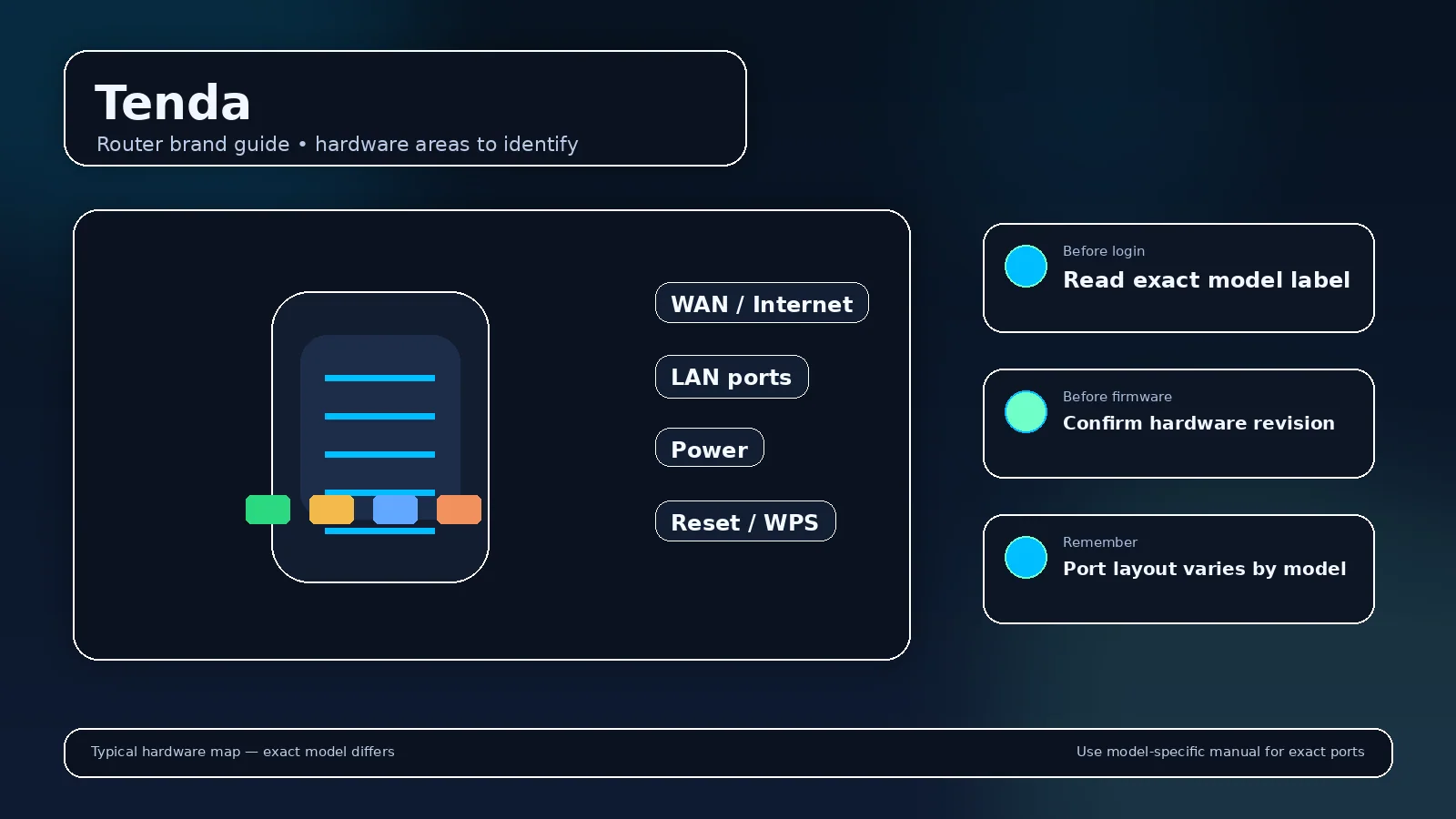
Tenda sells budget and mainstream home routers, mesh systems, extenders, and wireless CPE products across many regional markets. The local management address and login behavior can vary by product line and firmware, especially on ISP-customized units.
Finding the correct Tenda admin page
192.168.0.1 is a common local gateway on Tenda home routers, and many models also use a local setup hostname documented in their quick-start material. Rather than assuming the factory address, check the connected device’s default gateway when the network has already been configured.
Password behavior
Some older models used simple factory credentials or no separate admin password; newer setup flows can ask the owner to create one. The Wi-Fi password may also be reused as an admin credential on certain setup flows, but that should never be assumed without the exact model documentation.
When the router came from an ISP?
Carrier firmware can change the address, hide features, or replace manufacturer credentials with provider-specific access. Use the ISP’s instructions when they differ from retail Tenda documentation.
Tenda’s broad regional catalog requires model-level caution
Tenda sells budget routers, mesh systems, extenders and wireless CPE across many markets. 192.168.0.1 is common on standard home routers, but login credentials and setup behavior vary widely by model and firmware. ISP-customized units can use provider-specific addresses and locked settings.
Wi-Fi password versus administrator password
Some Tenda setup flows can reuse a wireless password for management while others create a distinct administrator credential. Never assume that pattern for an unknown model. Read the field label and exact manual before entering sensitive credentials.
Extender/mesh troubleshooting
After a repeater or mesh node joins the main network, its management IP may be assigned by upstream DHCP. If a factory address stops working, check the primary router’s connected-device list instead of resetting a functioning unit.
Low-cost hardware still needs lifecycle checks
Before relying on an older router as the internet-edge firewall, check whether firmware support is active and whether current Wi-Fi security modes are available. If the device cannot receive security updates, replacement can be more important than recovering a historical default password.
Before a factory reset
Save or photograph important settings first: WAN/PPPoE details, VLAN/IPTV values, Wi-Fi names, static reservations, port forwards, VPN configuration, DNS choices and any ISP/telephony settings. A reboot preserves configuration; a factory reset erases it. Reset only after you know how the internet connection and local network will be rebuilt.
After you regain access
- Use a strong unique administrator password.
- Install supported firmware updates through the vendor/provider method.
- Review remote administration and disable WAN-side access if it is not intentionally needed.
- Use WPA2-AES or WPA3 where supported and compatible.
- Check connected clients, guest/IoT isolation and obsolete convenience features you do not use.
- Back up a known-good configuration if the product provides export/backup.
What to check in a modern home-router interface?
Once you are authenticated, resist the urge to change several settings at once. First record the WAN status, LAN subnet, DHCP range, current DNS choice, Wi-Fi security mode and firmware version. Those values describe the network before the change and give you a rollback reference if a device stops connecting.
Wi-Fi settings that deserve care
SSID, passphrase, WPA mode, band steering, channel width and guest-network isolation can affect every client. Changing an SSID or passphrase disconnects devices immediately. A manual channel can improve a known interference problem, but forcing the widest channel or a fixed channel without measuring the environment can make performance worse. Use WPA2-AES or WPA3 when supported; avoid WEP and legacy TKIP.
A safe Tenda login and troubleshooting sequence
- Confirm ownership and model. Work only on equipment you administer. Read the full model, hardware revision and provider label.
- Join the correct LAN. Use trusted Wi-Fi or Ethernet. Guest networks can intentionally block management traffic.
- Read the current gateway. Factory addresses are clues, not guarantees after setup. Windows, macOS, iOS and Android can show the gateway/router assigned to the active connection.
- Open the local address directly. Type the numeric address or documented local hostname in the browser address bar. Do not search the password or paste credentials into a public website.
- Interpret the result. A login form proves network reachability; a timeout suggests address/routing/isolation trouble; rejected credentials are an authentication problem, not an IP problem.
- Use model-specific recovery. Check the label, manual, vendor/provider app and official recovery steps. Reset only after other recovery options fail.
When a source conflicts with your device?
Video walkthrough for Tenda
Useful when a factory router address no longer works: identify the gateway your device is actually using before changing passwords or resetting hardware.
How to Find Your Default Gateway or Router IP Address — YouTube networking tutorial. Watch on YouTube
Useful next steps
Document the upstream subnet before installing a Tenda router
Tenda: tenda home-networking products; check the exact model manual
- Tenda check: tenda home-networking products; check the exact model manual Official source 1
Illustrative case: A second router is added behind a gateway using the same subnet. Compare WAN and LAN networks, then plan a non-overlapping LAN rather than changing DNS blindly.
Documentation and scope