This site maintains a working reference for router administration, private gateway addresses, networking tools, and home-network troubleshooting. Router information changes across models, hardware revisions, firmware versions, regions, and ISP-customized devices, so our database is designed around scope and verification rather than a single “default password” list.
What we verify?
For router records, we separate several kinds of information: the local management address or hostname, administrator-login behavior, factory Wi-Fi credentials, model/revision scope, support documentation, and reset/setup procedures. These fields are not treated as interchangeable.
Source hierarchy
- Manufacturer manual or support documentation for the exact model/product family.
- ISP/provider documentation for carrier-supplied hardware.
- Manufacturer quick-start documentation and device-label instructions.
- Reliable secondary technical documentation when the primary source is unavailable.
- Community reports only as a lead or clearly labelled secondary evidence.
Why we avoid universal password claims?
An address such as 192.168.1.1 can be used by many unrelated routers. It does not determine the username or password. Likewise, a brand may have used one default on older products and a setup-created or device-unique password on newer hardware. We therefore avoid converting a model-specific fact into a brand-wide claim.
Claim-level sources
Important device-specific instructions are matched to the exact manual or support article that supports them. A manufacturer homepage or generic support portal is not treated as proof of a particular login flow, reset behavior, firmware menu, or credential. The evidence record also states the model, hardware revision, firmware family, provider variant, or region covered by the source.
Verification dates
A “last checked” date records when the factual data was actually reviewed. We do not update dates simply to make pages appear new. If a source has changed materially, the page should be rechecked and the date updated at the same time.
Observed equipment tests
Documentation research and physical testing are kept separate. A hands-on test is published only when we can record the exact equipment/model and hardware revision, firmware/software version, connection type, exact symptom or error, one action/check, the observed result, evidence date, and a redacted screenshot or other evidence reference. Failed tests are retained when they are diagnostically useful. Hypothetical examples are never labelled as observed results.
Screenshots and visual evidence
Original screenshots should show the exact field, menu, warning, or result the reader needs to recognize. Captions identify the model/revision and firmware or software context. Passwords, serial numbers, public IP addresses, account names, recovery keys, and other sensitive details are hidden before publication. When an original screenshot is not available, we may link to an official manufacturer/provider screenshot and clearly attribute the source rather than recreating it as first-hand evidence.
FAQs from real problems
FAQ topics are drawn from recurring support symptoms, community discussions, correction/contact messages, and—after launch—site search and search-query data. Community discussions are used to identify the question, not to establish a model-specific default. The answer states the relevant exception and the next diagnostic check, with primary documentation linked when the answer makes a device-specific claim.
Indexing policy
Database records can exist in WordPress before they are suitable for public search. Router brand, IP, and model pages remain drafts until they have enough unique value and an editor explicitly publishes them. This lets the database grow without exposing unfinished placeholder pages.
Corrections
When we find a factual problem, we correct the data and its scope rather than hiding the issue behind additional generic text. See the Corrections Policy for the process.
What did we test in theme version 1.10.0?
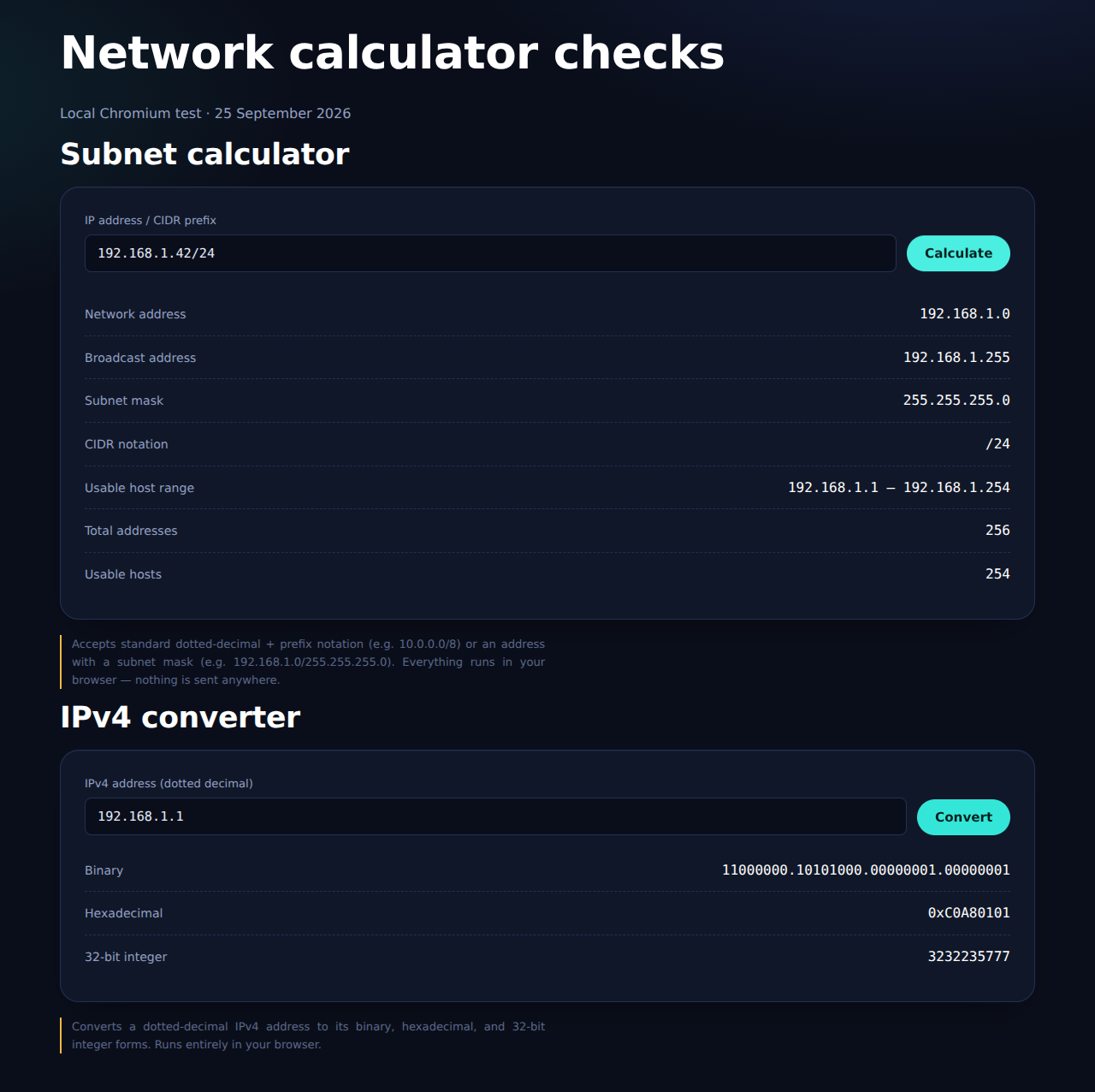
On 25 September 2026, the theme’s calculator templates and JavaScript were executed locally in headless Chromium. The test used the shipped code and controlled inputs; it did not connect to a physical router or a production WordPress database. Nineteen browser checks passed without JavaScript errors in that fixture.
| Check | Observed result |
|---|---|
| 192.168.1.42/24 | Network 192.168.1.0; broadcast 192.168.1.255. |
| 192.0.2.0/31 | Two addresses, no broadcast; point-to-point assumption disclosed. |
| 192.0.2.1/32 | One address; broadcast not applicable. |
| Noncontiguous 255.0.255.0 mask | Rejected, with previous results cleared. |
| 192.168.1.1 conversion | Hexadecimal 0xC0A80101; integer 3232235777. |
| Malformed IPv4 input | Empty octets, out-of-range octets, exponent/hex forms and ambiguous leading zeroes were rejected. |
| 390px and 1440px component layouts | FAQ opening worked; no document-wide horizontal overflow. |
What does a reference establish?
A model-specific manual can support a particular address or menu path within its stated firmware scope. A manufacturer’s general support portal is only a starting point for finding the correct manual; it does not establish every setting on every device. Pages distinguish those limits and label hypothetical troubleshooting cases as illustrative.
Checks that require an installed website or real hardware
These local results do not establish production DNS, WHOIS, port-checking or mail delivery behavior. Server-backed tools depend on the host, outbound connectivity and service limits. Actual router credentials, app screens, provider restrictions and radio performance require the matching equipment and account. No physical-device test is claimed here.
After deployment, check HTTP responses, canonical URLs, robots directives, canonical URLs, sitemaps, mobile behavior and speed on the actual domain. Documentation review dates should be recorded only when the relevant source has been checked; an automated seed date is not evidence of review.